¶ Users
TecCom Portal allows us to add and manage users for our TecOrganization, and also to customize the access for each of them.
For login issues, please visit: Known Login Issues.
To access user management choose Admistration > Users in the navigation menu. This menu item is available only if you have administrator role in the organization that is selected and displayed beside your user name in the upper, right corner.
In the TecCom Portal two different user roles are offered:
- User
- Administrator
Depending on the role assigned, the user has role-specific default permissions. For example, menu items are displayed or certain features are permitted depending on the role of the user. Additionally for User role the permissions can be customized per organization.
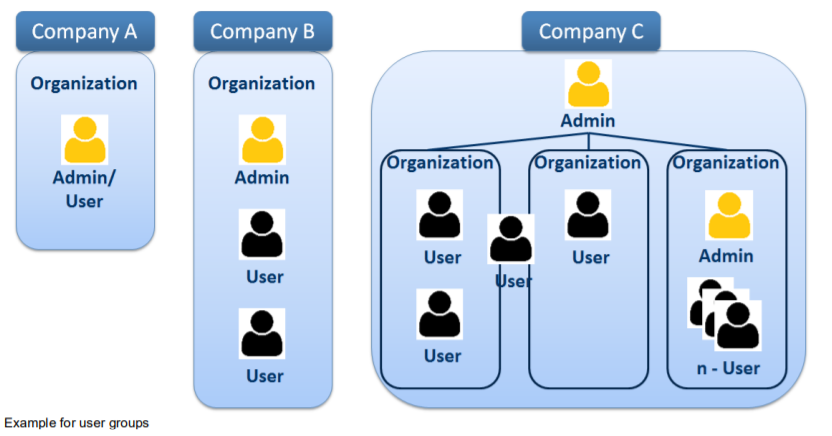
You can adapt the TecCom Portal to your corporate structure by freely deciding on the allocation of users and administrators in the organizations. Different constellations can be mapped. For each organization, a separate TecCom ID is required.
In the User management view an administrator can:
- view a list of all users belonging to your organization
- view and modify user profile
- administer user roles and permissions
- add a new user to your organization
- add multiple users to your organization by importing user list from a csv file
- remove a user from an organization
¶ List of users
The Users page provides an overview of users assigned to a selected organization.
The organization list is displayed on the left side of the page. It contains organizations where you have an administrator role. You can use the search field to find the required organization. After you select an organization, the table on the right side displays users assigned to this organization.
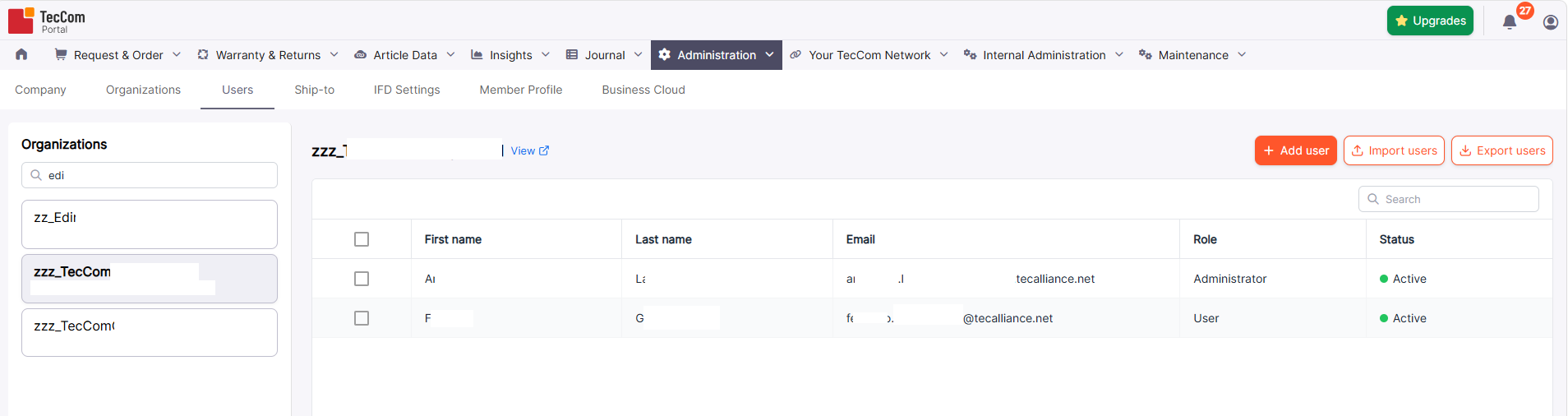
The selected organization name is shown above the table. The View link next to the organization name allows you to open the organization details page.
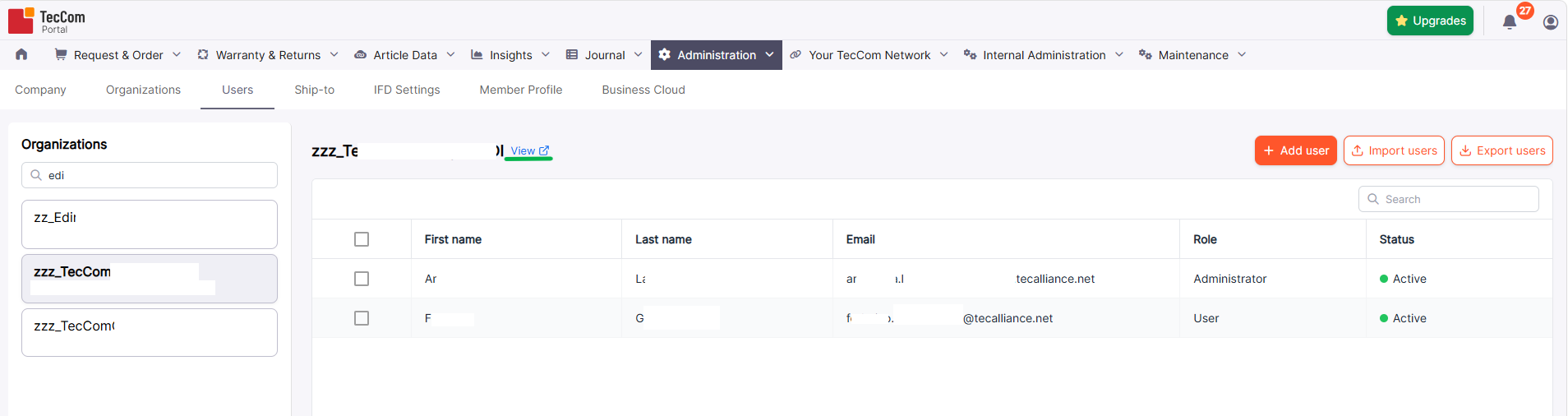
The user list includes the user’s first name, last name, email address, role, and account status. User roles can be Administrator or User.
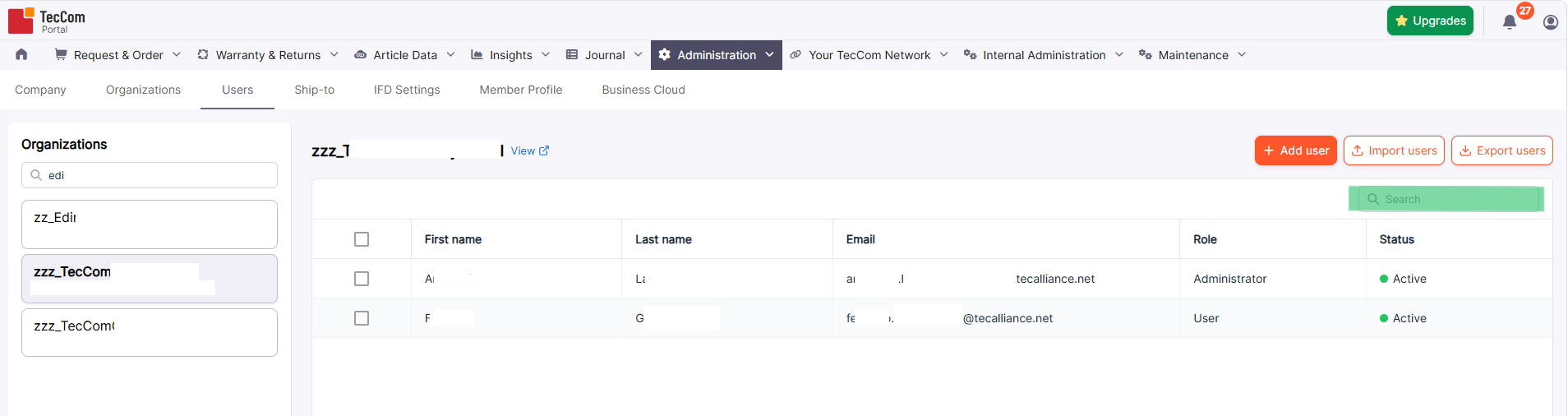
To find a specific user within the selected organization, use the search field above the table. The search works by first name, last name, and email address.
The table can be sorted by column values. To sort the list, hover over a column header and click the sorting icon.
¶ Add a new user
Administrators can add new users to organizations where they have an administrator role.
To add a new user:
- Open the Users page and select the required organization from the organization list on the left side of the page.
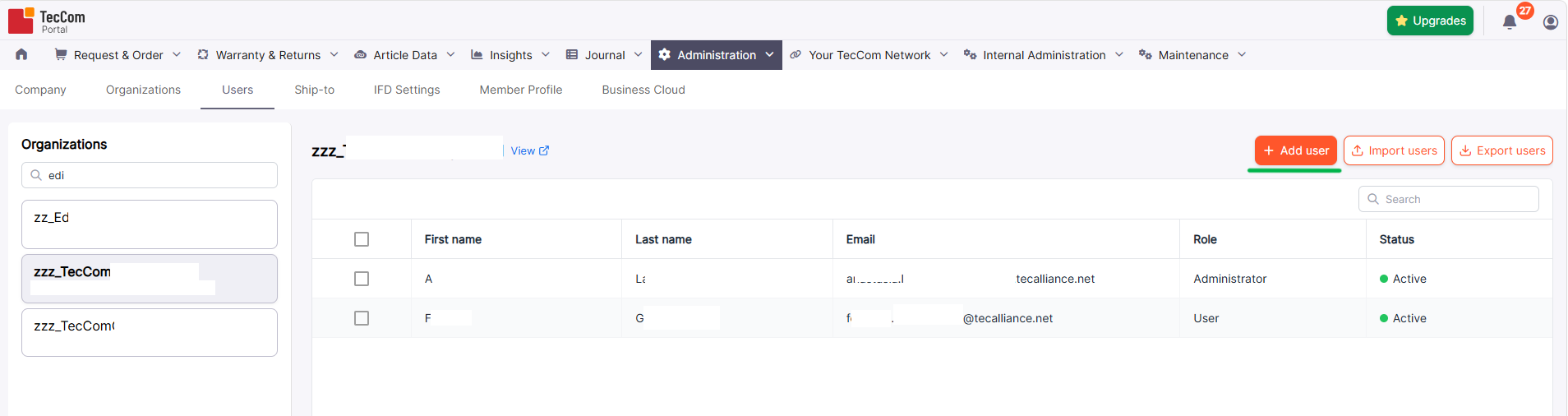
- Click +Add user in the top-right corner of the page.
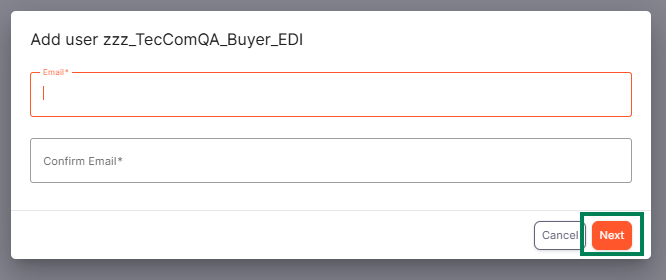
- In the Add user window, enter the Email address of the new user and repeat it in the Confirm Email field.
- Click Next.
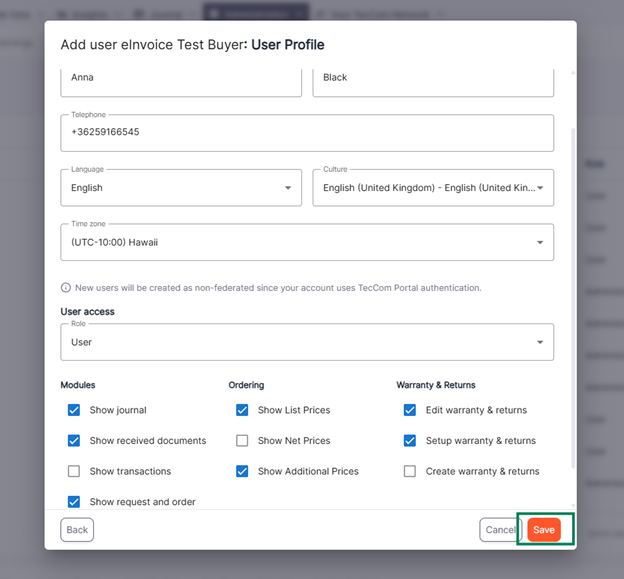
- On the User Profile step, enter the user’s personal data: First name, Last name, and Telephone.
- Select Language, Culture, and Time zone. These settings are used for correspondence, date and time formats, number formats, and time-related information in the portal.
- Depending on your own authentication type, new users will be created either as federated or non-federated users.
- If your account uses TecCom Portal authentication, new users will be created as non-federated users.
- If your account uses federated authentication, new users will be created as federated users.
This behavior is defined automatically and cannot be changed manually in the standard user creation flow.
- In the User access section, select the user role: Administrator or User.
- If the Administrator role is selected, all permissions are automatically granted.
- If the User role is selected, select the required permissions manually.
- If the User role is selected, choose the required permissions.
Permissions are grouped by functional area: Modules, Ordering, and Warranty & Returns.
Modules
- Show journal - allows the user to access the Journal menu.
- Show received documents - allows the user to read and download reverse messages.
- Show transactions - allows the user to access the Transactions list view.
- Show request and order - allows the user to access the Request & Order menu.
- Show e-Invoices - allows the user to access the e-Invoices page.
Ordering
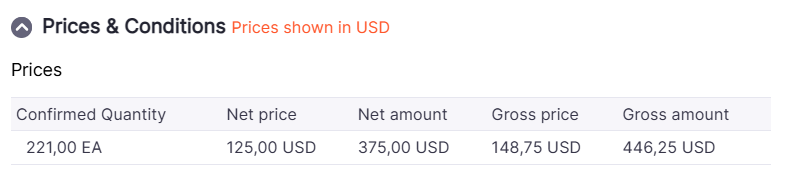
- Show List Prices - shows or hides gross price and gross amount in Product Detail and Order in OrderPro / Classic Basket and Document Hub / Journal.
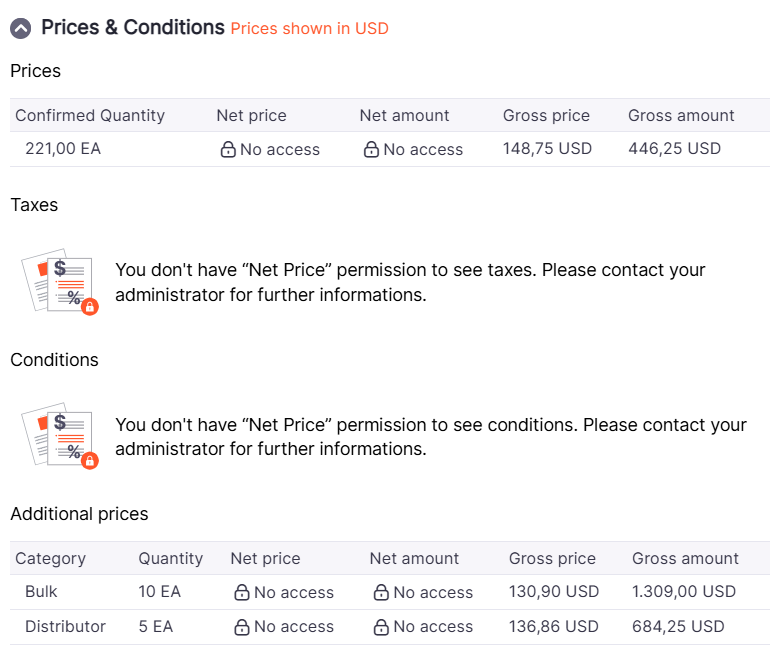
- Show Net Prices - shows or hides net price, net amount, tax, and conditions in Product Detail and Order in OrderPro / Classic Basket and Document Hub / Journal.
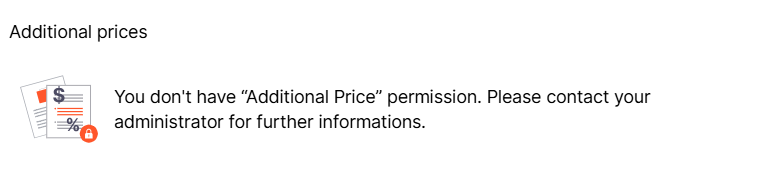
- Show Additional Prices - shows or hides the additional prices table in Product Detail and Order in OrderPro / Classic Basket and Document Hub / Transactions.
Warranty & Returns
- Edit warranty & returns - allows the user to edit claims in Warranty & Returns.
- Create warranty & returns - allows the user to create claims in Warranty & Returns, for example by adding or importing them.
- Setup warranty & returns - allows the user to set up claims in Warranty & Returns, for example copy, delete, or send claims.
- Click Save to create the user.
¶ Import users
The Import users function allows administrators to add multiple users to the selected organization at the same time by uploading a CSV file.
You can import up to 500 unique users per request.
There are two ways to prepare a file for import:
- Use the CSV template provided in the import window.
- Use a CSV file created with the Export users function.
An exported file can be imported again without changing its structure. For example, to assign the same users with the same permissions to another organization, but before that update the OrganizationTecId in the exported file before importing it.
To import users:
- Open the Users page and select the required organization from the organization list on the left side of the page.
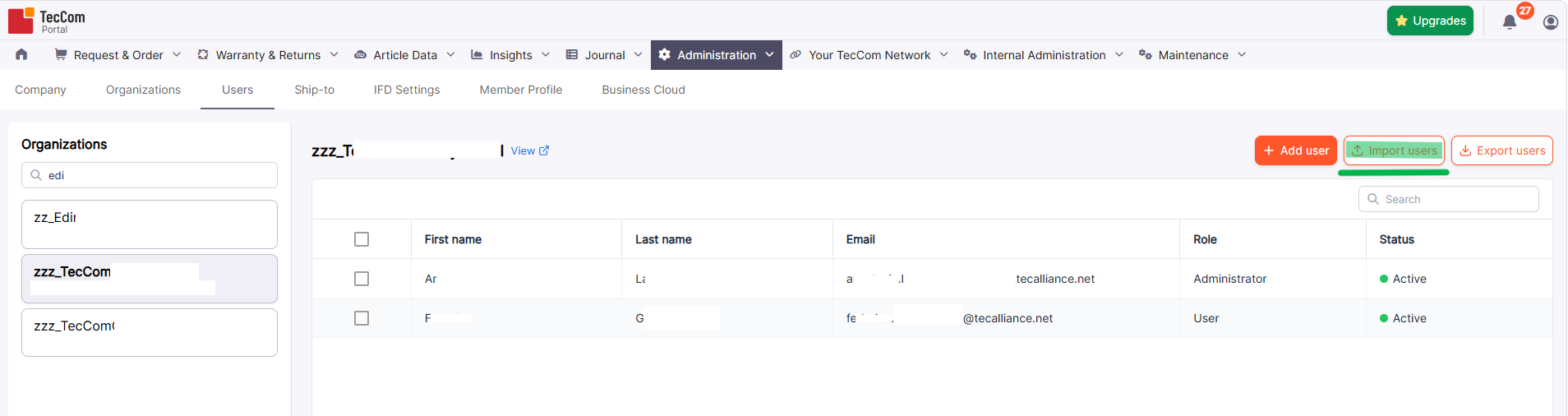
- Click Import users in the top-right corner of the page.
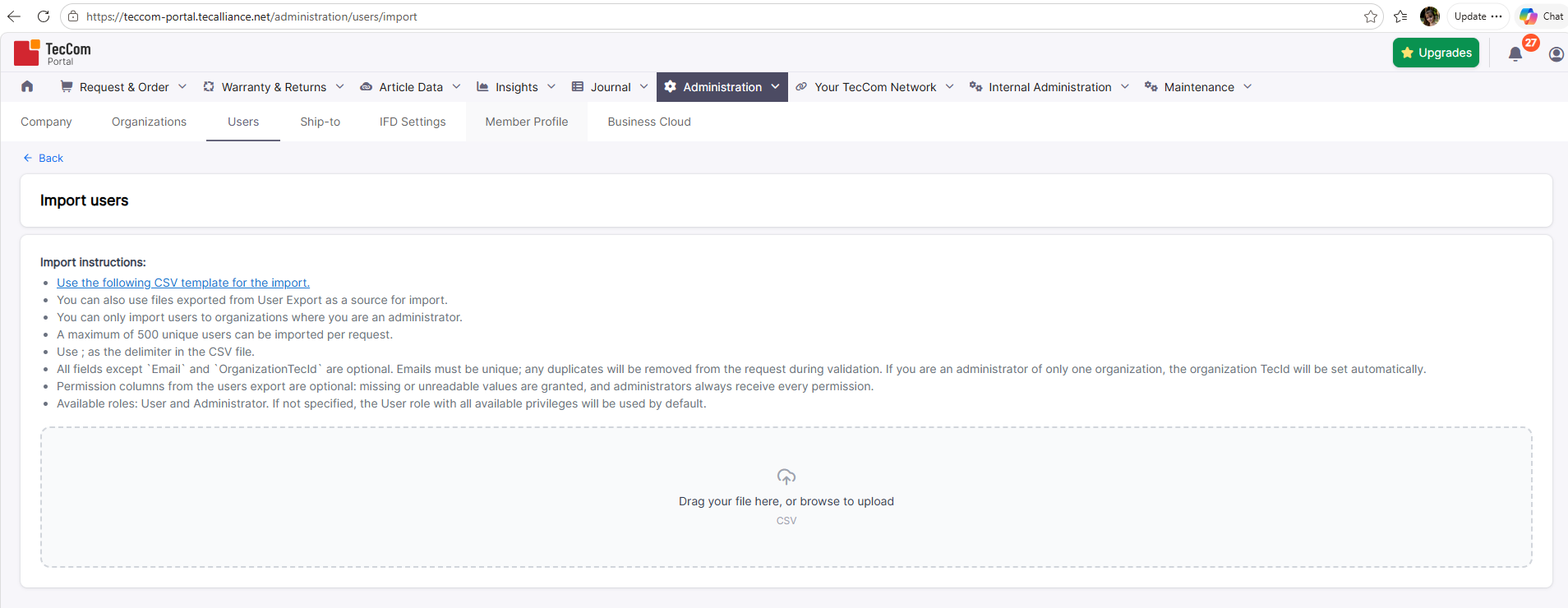
- In the Import users window, review the import instructions.
The import file must meet the following requirements:
- Use the CSV template provided in the import window or a file created with the Export users function.
- A maximum of 500 unique users can be imported per request.
- Use ; as the delimiter in the CSV file.
- The file must be in CSV format.
- Email and OrganizationTecId are required.
- All other fields are optional.
- The same user can be included for different organizations by using different OrganizationTecId values.
- Available roles are User and Administrator.
- If no role is specified, or if the role value is unsupported, the User role is used by default.
- Permission columns are optional.
- If a permission value is empty or cannot be interpreted, the permission is enabled by default.
- If the Administrator role is selected, all permissions are granted automatically.
- Download the CSV template from the link in the import instructions, or prepare a file created with the Export users function.
The standard import template contains the following fields: OrganizationTecId; FirstName; LastName; Email; Phone; Role
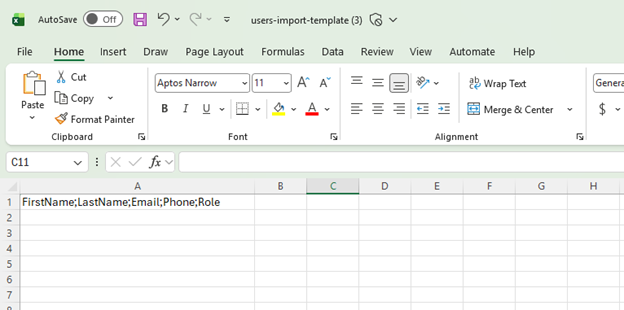
A file created with Export users contains the following fields: OrganizationTecId; OrganizationName; FirstName; LastName; Email; Role; ShowListPrices; ShowNetPrices; ShowAdditionalPrices; ShowReceivedDocuments; ShowJournal; ShowTransactions; ShowRequestAndOrder; ShowInvoices; EditWarrantyReturns; CreateWarrantyReturns; SetupWarrantyReturns.
Note: OrganizationName is optional. The organization is identified by OrganizationTecId. Importing a different organization name does not overwrite the organization name stored in the portal.
- Fill in the CSV file with the required user data.
If you reuse an exported CSV file to add users to another organization, update the OrganizationTecId to the TecId of the target organization.
Permissions from the exported file can be reused for the new organization. - Upload the CSV file.
You can either drag the file into the upload area or browse for the file manually. - Click Next.
- Review the uploaded users on the Preview step.
The preview shows the organizations and users detected in the uploaded file. You can use the search fields to find a specific organization or user.
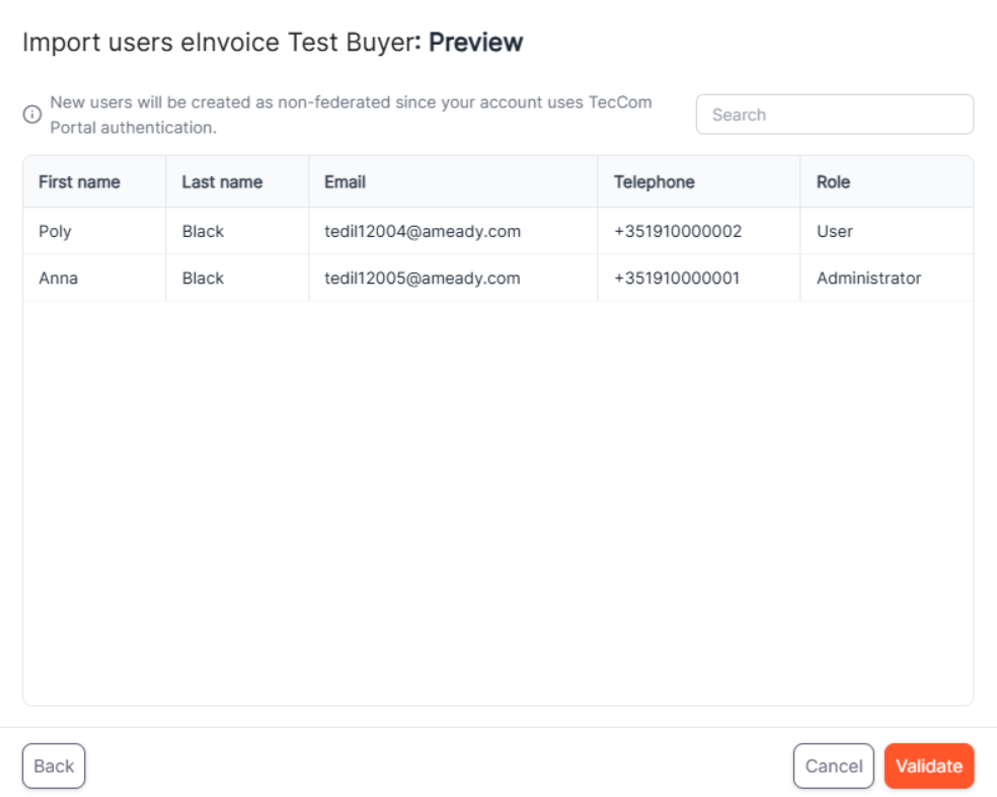
The portal checks the uploaded rows before validation.
If the same email address is repeated for the same organization with conflicting information, the affected rows are marked as conflicting and excluded from validation.
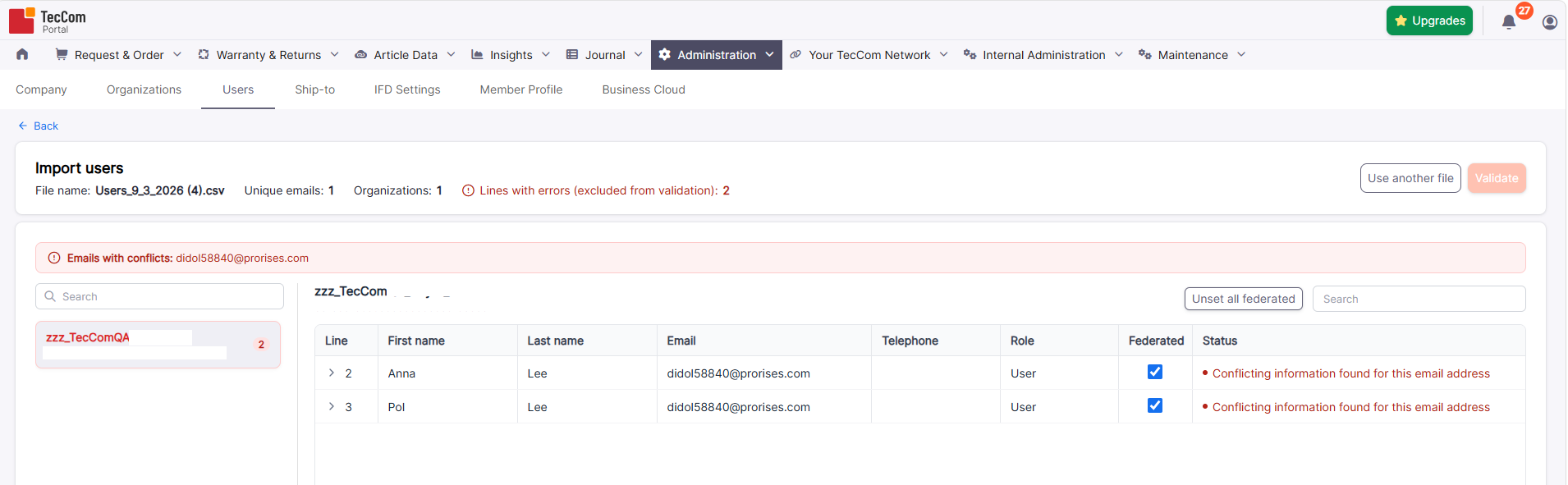
If identical duplicate rows are included for the same user and organization, duplicate entries are ignored.
The same email address can be used in multiple rows when the user is being assigned to different organizations.
- Depending on your authentication configuration, the Federated setting may be available for new users on the Preview step.
Depending on your own authentication type, imported users will be created either as federated or non-federated users.
- If your account uses TecCom Portal authentication, imported users will be created as non-federated users.
- If your account uses federated authentication, imported users will be created as federated users.
This behavior is defined automatically and cannot be changed manually in the standard import flow.
- Click Validate.
- Review the Validation results.
The validation results are divided into the following tabs:
- New users - users who do not yet exist and can be created during the import.
- Existing users - users whose email addresses already exist in the system. These users will not be created again, but they can be added to the selected organization.
- Errored users - users who cannot be imported because their data contains validation errors.
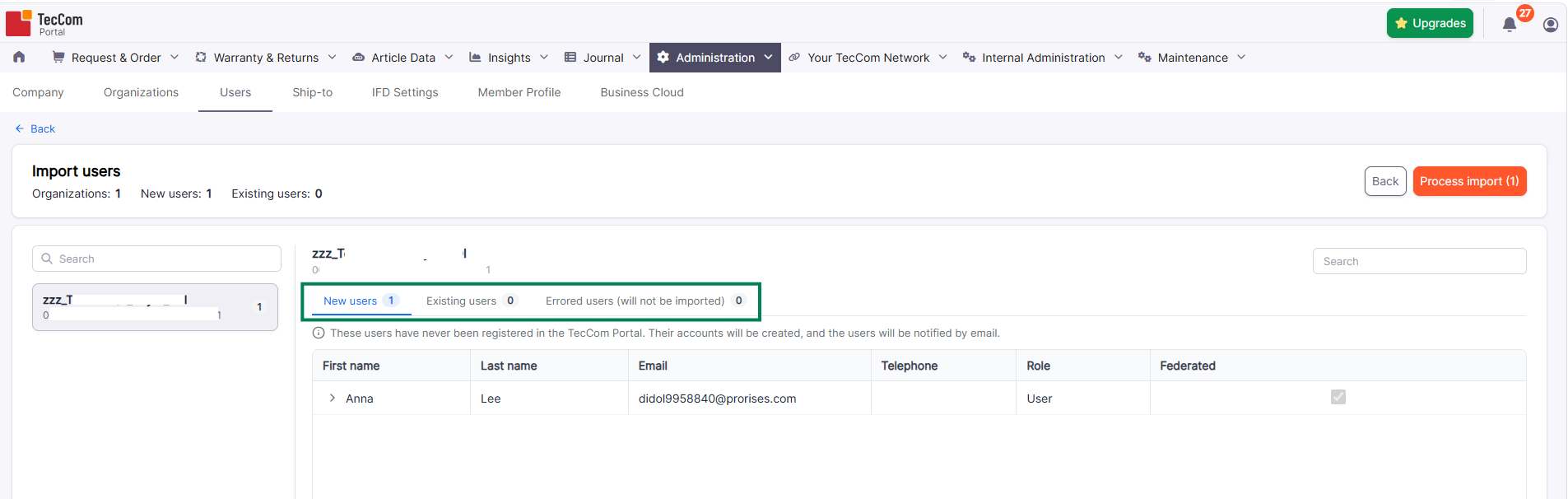
If the same user is imported more than once for the same organization with different permissions, the first valid entry in the file is used. Later duplicate entries do not overwrite it.
- Review any users listed under Errored users (will not be imported).
Valid users can still be processed even if other entries in the file contain errors. - Click Process import.
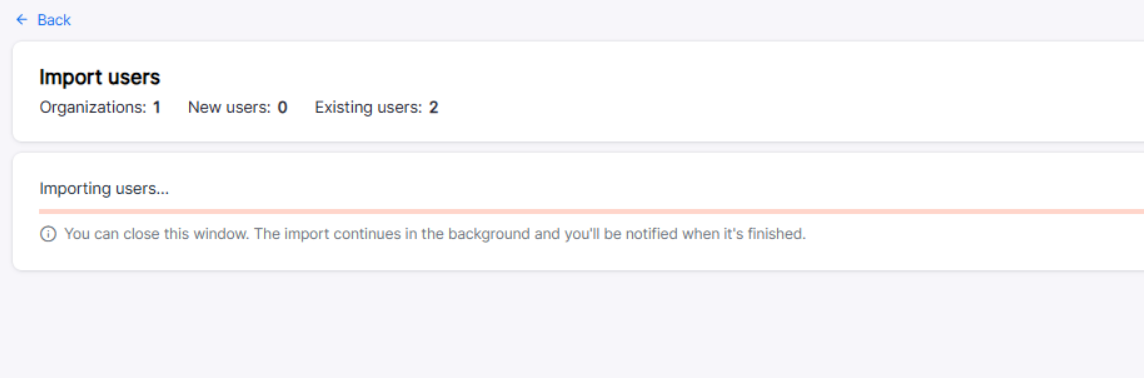
- The import starts in the background.
You can leave the page while the import is running. The process continues in the background and you will receive a notification when it is finished.
- When the import is complete, a notification appears in the portal notification center.

The notification and report remain available for up to 30 days.
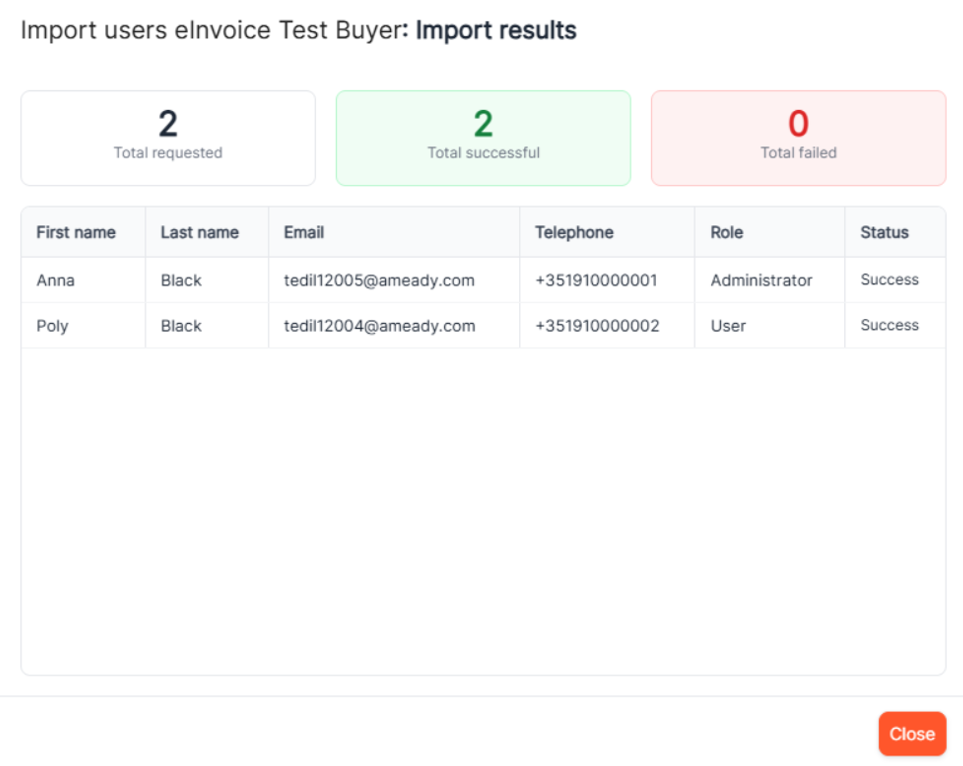
- Review the Import results.
The report shows:
- Total requested — the total number of entries processed by the import.
- Total successful — the number of entries imported successfully.
- Total failed — the number of entries that could not be imported.
For each imported user, the table shows the user data, role, status, and organization where applicable.
Expand a row to view the permissions applied to the user.
- Click Close to finish the import process.
¶ Possible import errors
During the import process, the system validates the uploaded CSV file.
Entries that contain validation errors are not imported. Other valid entries in the same request can still be processed.
Possible validation errors include:
- Email is empty — the email field is required. Add a valid email address for the user.
- OrganizationTecId is empty — the organization TecId is required. Add the TecId of the organization where the user should be assigned.
- OrganizationTecId is invalid — the specified organization cannot be used for the import. Check the organization TecId.
- More than 500 unique users — a maximum of 500 unique users can be imported in one request. Split the users into multiple import files.
- Conflicting information for the same email address — the same user is included more than once for the same organization with different user data, role, or permissions. Correct the conflicting rows and upload the file again.
- First name exceeds 50 characters — shorten the first name to 50 characters or fewer.
- Last name exceeds 50 characters — shorten the last name to 50 characters or fewer.
- Email exceeds 254 characters — use an email address with 254 characters or fewer.
- Phone exceeds 25 characters — shorten the telephone number to 25 characters or fewer.
If the CSV file contains an unsupported role, for example Manager, this is not treated as an import error. The User role is used instead.
Only the following roles are supported:
- User
- Administrator
Permission values in files created with Export users must use true or false.
If a permission value is empty or contains another value, the permission is enabled by default.
If the role is Administrator, all permissions are enabled automatically.
¶ Export users
The Export users function allows administrators to export user data, organization assignments, roles, and permissions to a CSV file.
The exported CSV file can also be used as a source file for a later user import.
There are two ways to export users:
- Export selected users from the current organization;
- Export all users from one or more organizations.
Export selected users
To export specific users from the currently selected organization:
- Open the Users page and select the required organization.
- Select one or more users using the checkboxes in the user list.
When at least one user is selected, an action bar appears at the bottom of the page.
- Click Export users (N), where N is the number of selected users.
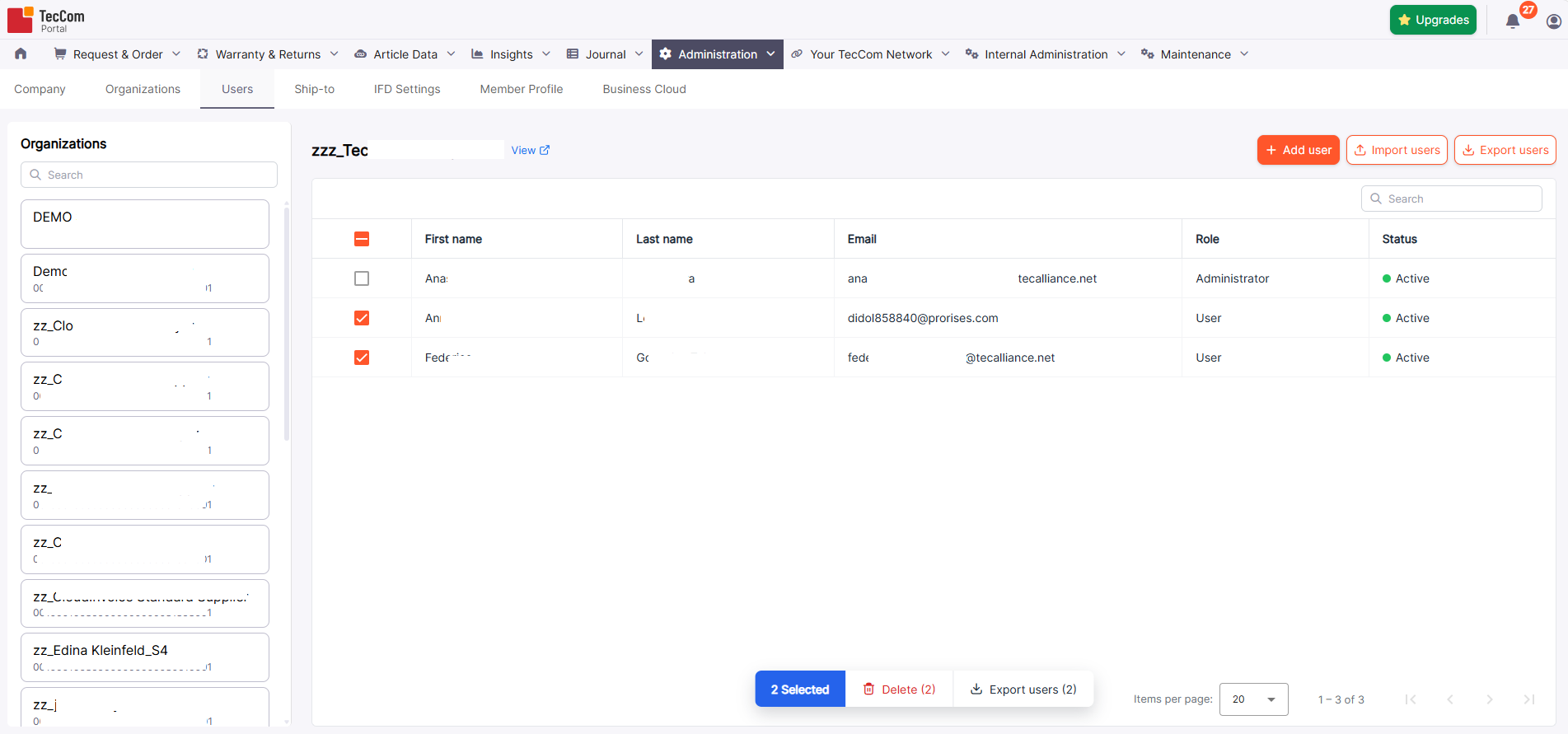
Only the selected users from the current organization are included in the export.
Export users from organizations
To export all users from one or more organizations:
- Open the Users page.
- Click Export users in the top-right corner of the page.
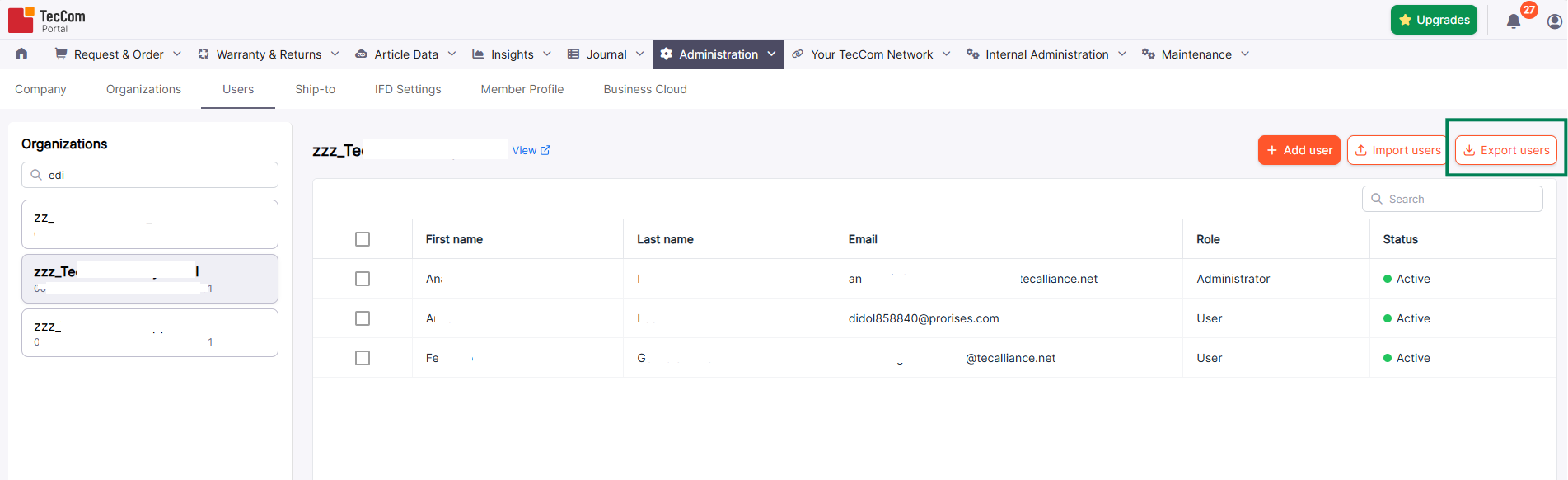
- In the Export users window, select one of the following options:
- Export all users for current organization — exports all users assigned to the organization currently selected on the Users page.
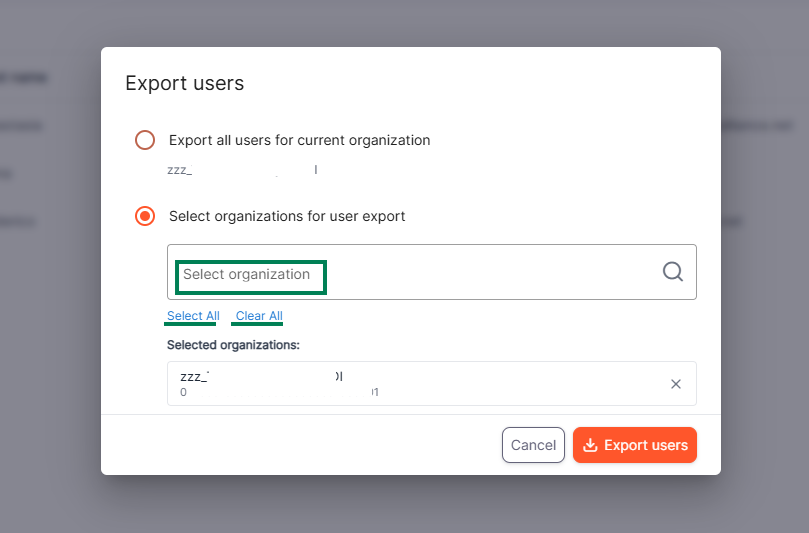
- Select organizations for user export — allows you to select one or more organizations for the export.
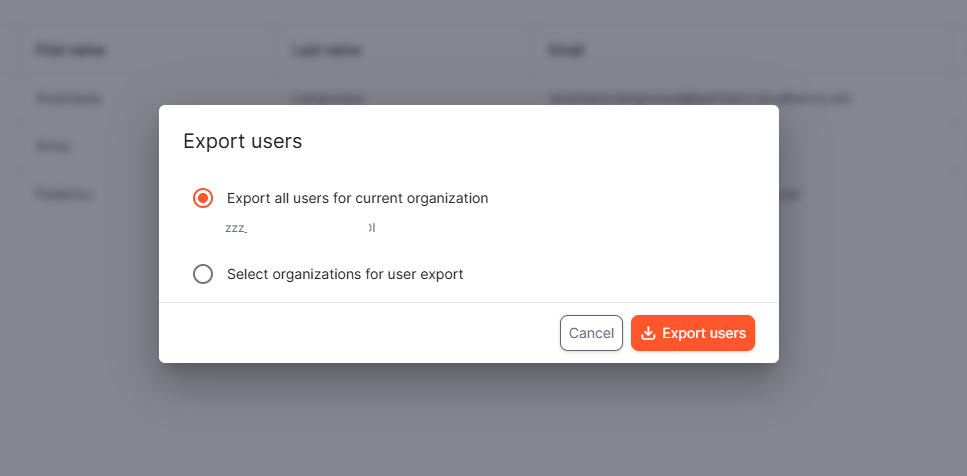
- If you select Select organizations for user export, choose the required organizations.
You can search for organizations, select multiple organizations, or click Select All to include all available organizations.
-
Click Export users.
The export is processed in the background and a confirmation message indicates that the file is being prepared. -
When the export is complete, a notification appears in the portal notification center.
Open the notification to download the generated CSV file.
The export notification and file remain available for up to 30 days.
Export file structure
The exported CSV file contains the following fields:
OrganizationTecId; OrganizationName; FirstName; LastName; Email; Role; ShowListPrices; ShowNetPrices; ShowAdditionalPrices; ShowReceivedDocuments; ShowJournal; ShowTransactions; ShowRequestAndOrder; ShowInvoices; EditWarrantyReturns; CreateWarrantyReturns; SetupWarrantyReturns
The file contains one row for each user-organization assignment.
If the same user belongs to more than one exported organization, the CSV file contains a separate row for each organization. This allows the user’s role and permissions to be exported independently for each organization.
The exported file can be uploaded again using the Import users function.
To assign the exported users to another organization while keeping the same roles and permissions, change the OrganizationTecId to the TecId of the target organization before importing the file.
¶ User access profile
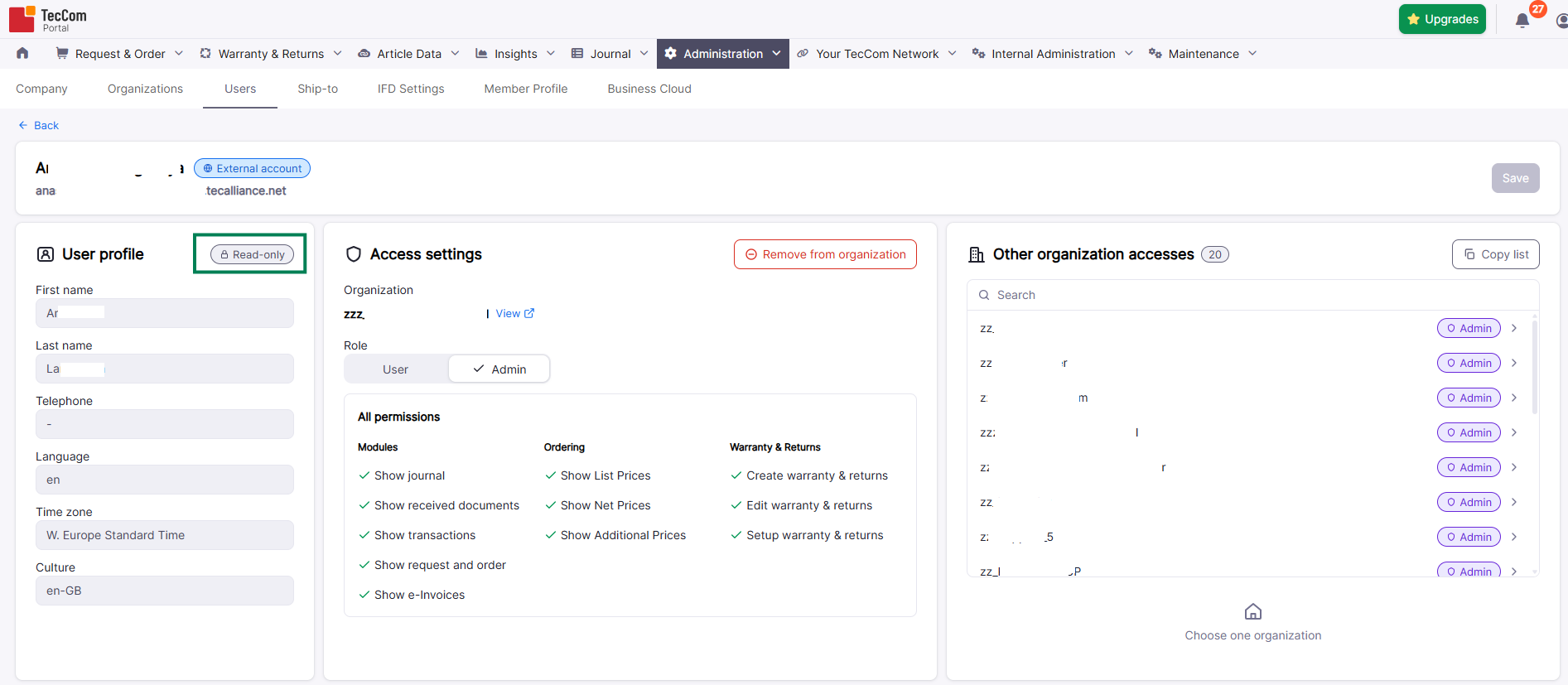
An administrator can open the User access profile page by clicking a user in the Users list.
The page provides information about the selected user and their access to the current organization.
The page consists of:
- User profile
- Access settings
- Other organization accesses, if the user has access to more than one organization
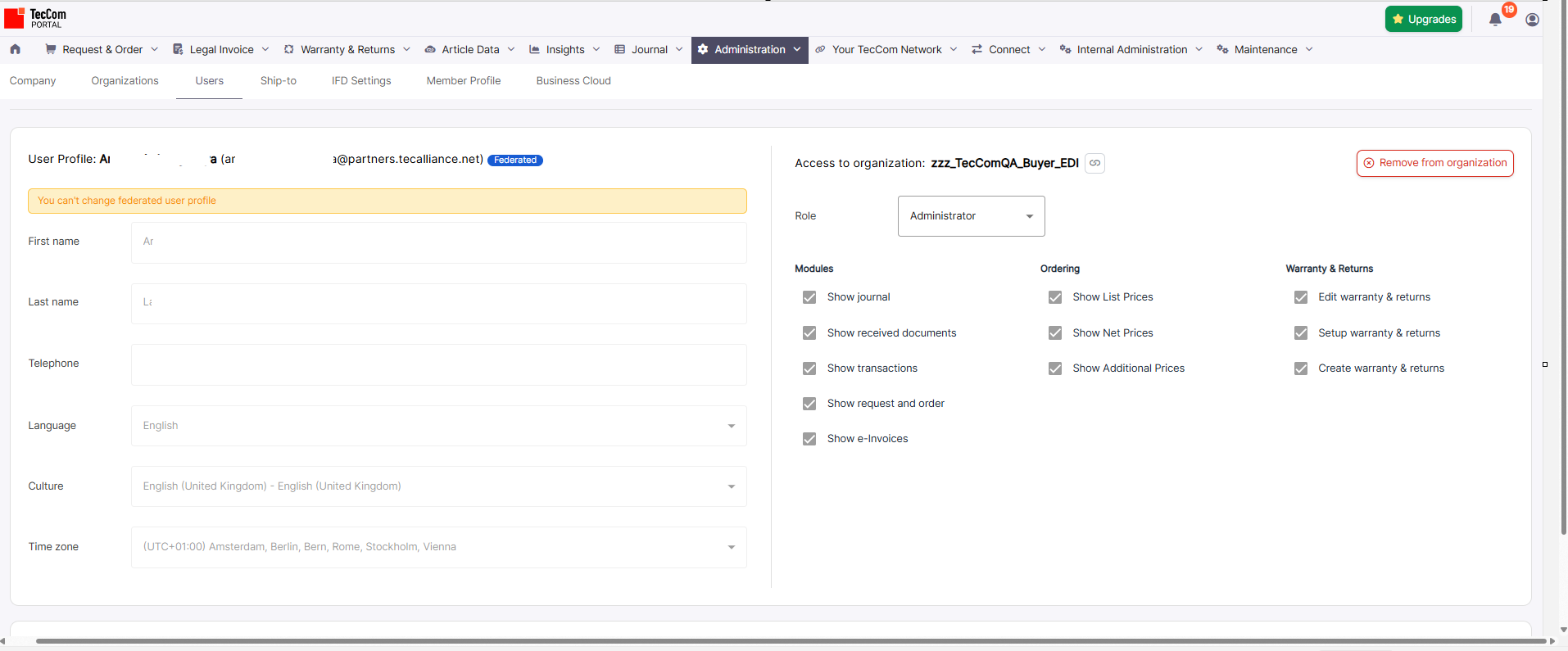
User profile
The User profile section contains the user’s personal and regional settings.
For non-federated users, an administrator can view and update:
- First name
- Last name
- Telephone
- Language
- Culture
- Time zone
For an External / Federated user, the user profile is displayed as read-only and cannot be changed in the TecCom Portal.
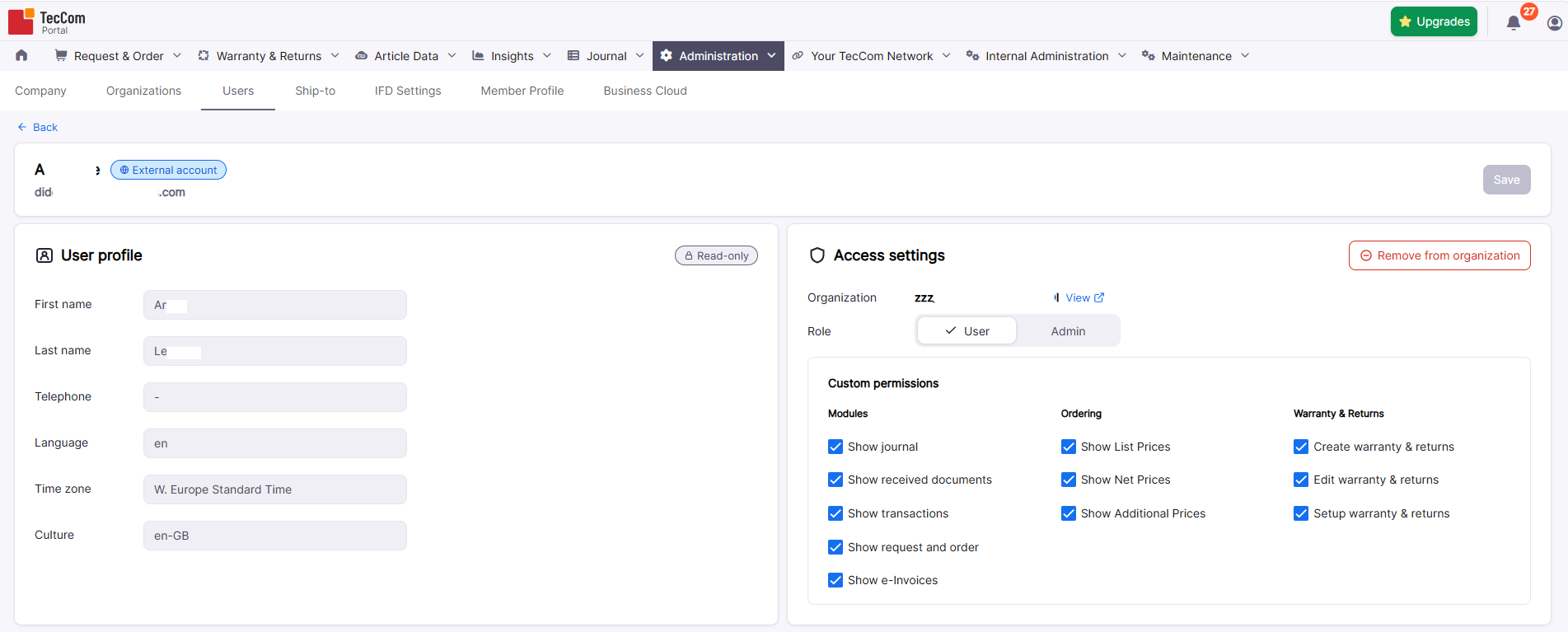
Access settings
The Access settings section shows the organization for which the user access profile is currently displayed.
An administrator can:
- View the current organization;
- Open the organization details using the View link;
- Change the user role;
- View and update permissions for the current organization;
- Remove the user from the current organization.
Available roles are:
- User
- Admin
If the User role is selected, permissions can be configured individually in the Custom permissions section.
Permissions are grouped by functional area.
Modules
- Show journal
- Show received documents
- Show transactions
- Show request and order
- Show e-Invoices
Ordering
- Show List Prices
- Show Net Prices
- Show Additional Prices
Warranty & Returns
- Create warranty & returns
- Edit warranty & returns
- Setup warranty & returns
If the Admin role is selected, all permissions are granted automatically and cannot be changed manually.
If the role is changed from Admin back to User, the permissions become editable.
After making changes to the user profile, role, or permissions, click Save.
The Save button is enabled only after changes have been made.
External / Federated users
For an External / Federated user, the personal data in the User profile section is read-only.
The user’s role and permissions for the current organization can still be managed in the Access settings section.
Other organization accesses
If the user has access to more than one organization, the Other organization accesses section is displayed.
The number next to the section title shows how many other organizations are available for this user.
Select an organization in the list to view the user’s role and permissions for that organization.
The access settings shown in this section are read-only. Selecting another organization here does not change the organization currently displayed in the main Access settings section.
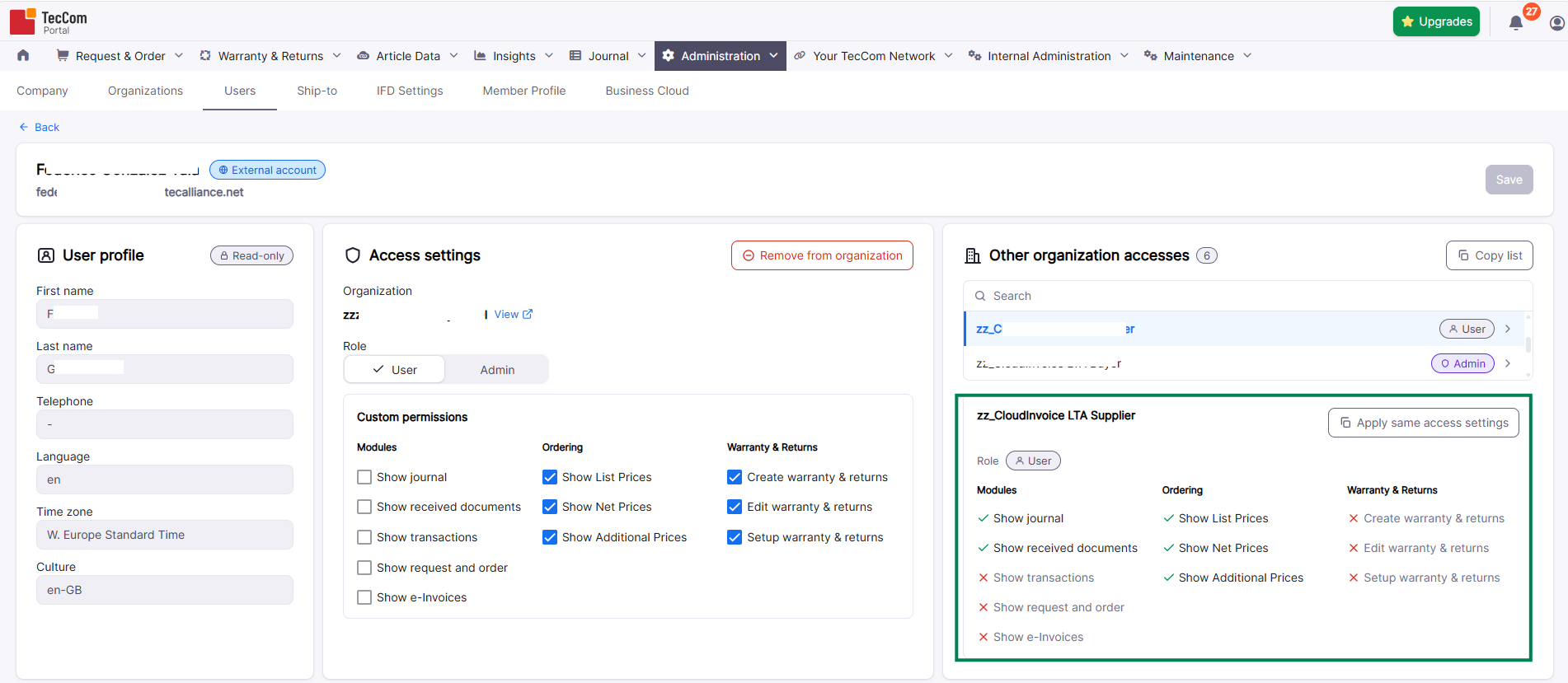
The Copy list button copies the names of the organizations shown in the list.
The Apply same access settings function allows you to copy the role and permissions from the selected organization in Other organization accesses to the current organization.
To copy access settings:
- Select an organization in the Other organization accesses list.
- Review the role and permissions displayed for the selected organization.
- Click Apply same access settings.
The role and permissions are copied to the current organization. - Click Save to apply the changes.
The copied settings are not saved automatically.
After the settings are copied, the following message is displayed:
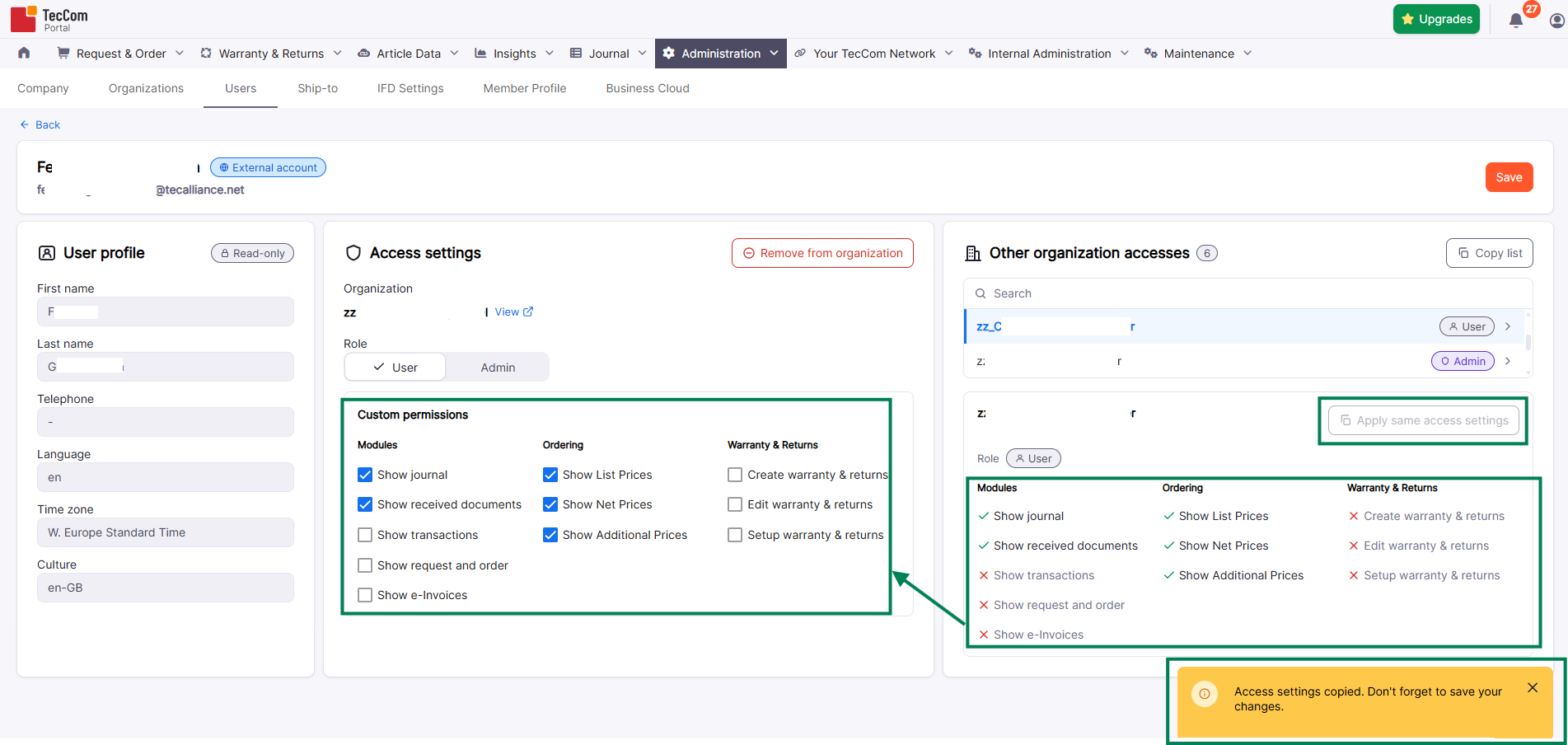
Note: Access settings can be copied from one selected organization at a time and don't forget to Save your changes.
¶ Remove a user from an organization
An administrator can remove a user’s access from an organization where they have an administrator role.
To remove a user from an organization:
- Open the Users page.
- Select the required organization.
- Click the required user in the user list.
- In the Access settings section, click Remove from organization.
- In the Remove user confirmation window, confirm the action.
- Click Yes to remove the user from the organization.
- Click No to cancel the action.
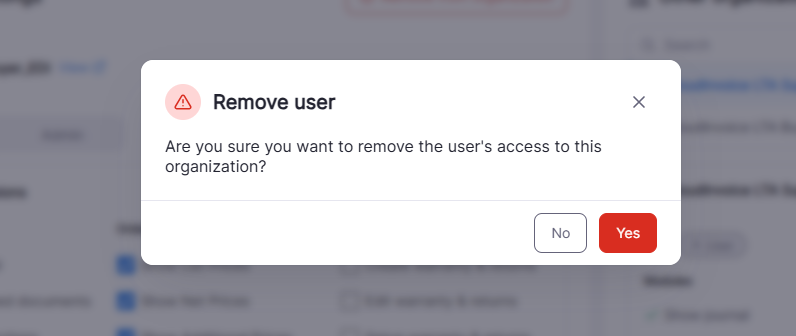
After the user is removed, they will no longer have access to this organization.
If the user still has access to other organizations, their user profile remains in the TecCom Portal.
After the removal is completed, you are redirected to the Users page.
¶ How Users setting affects to the OrderPro
¶ Price permissions
An organization's admin can control access to product prices and amount in an order through price permissions in the image below:
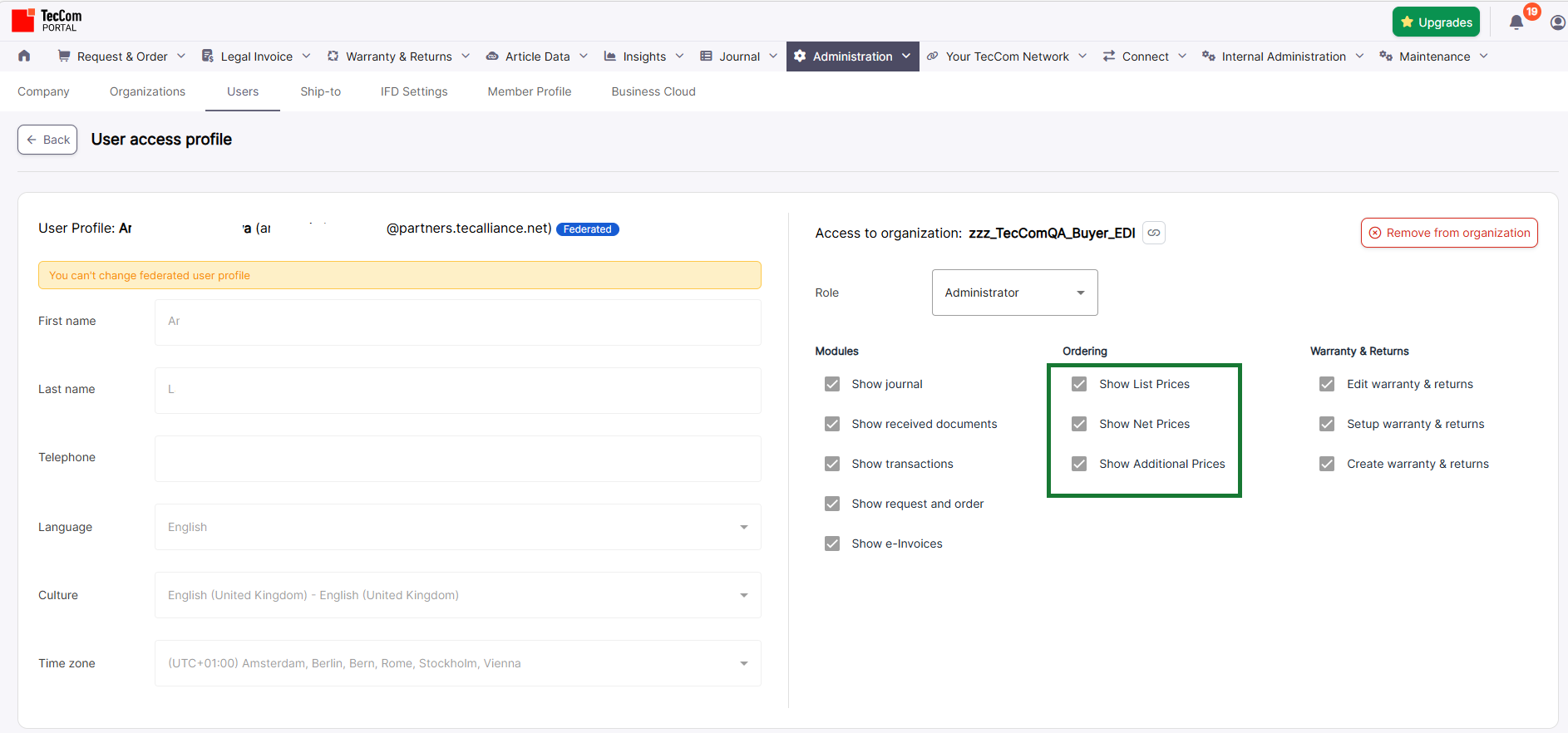
- Show List Prices: show/hide gross price and gross amount of products in an order
- Show Net Prices: show/hide net price and net amount of products in an order
- Show Additional Prices: show/hide additional prices table
To see where these permissions are applied in OrderPro, open an order in OrderPro, hover on the first column of any row in the Product Table and click on the Details button then scroll up & down to find Prices & Conditions and Additional Prices headers.
You can configurate price visibility for each user in Order Pro.
Below are some images as examples: